
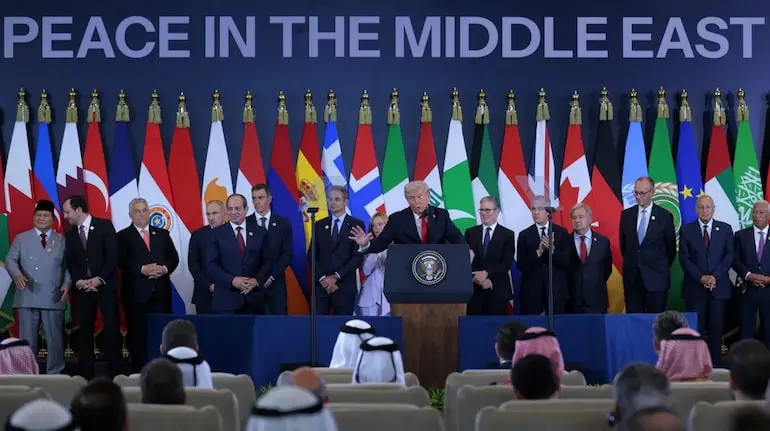
Trump’s “Board of Peace”: A New Experiment in West Asian Conflict Management
In January 2026, eight Islamic countries—including Saudi Arabia, Türkiye, Pakistan, Qatar, Egypt, Jordan, Indonesia, and the UAE—agreed to join U.S. President Donald Trump’s proposed “Board of Peace”, unveiled during Phase-II of the fragile ceasefire between Israel and Hamas. The initiative, backed by a UN Security Council resolution, marks an unusual attempt to institutionalise post-conflict governance in Gaza through a multilateral, transitional mechanism.
What is the “Board of Peace”?
The Board of Peace is envisioned as a temporary international administrative framework aimed at stabilising Gaza after prolonged conflict. According to the U.S. proposal, the body will focus on:
- Strengthening governance capacity
- Facilitating reconstruction and humanitarian recovery
- Mobilising large-scale international funding
- Rebuilding regional trust and diplomatic engagement
- Supporting a pathway towards a permanent ceasefire
The initiative is part of a broader Comprehensive Plan to End the Gaza Conflict, endorsed by the UN Security Council, which explicitly links peace-building with Palestinian self-determination and statehood under international law.
Significance of Islamic Nations’ Participation
The collective decision of eight Muslim-majority countries to join the Board is politically significant for several reasons:
- Regional Legitimacy: Participation by key Arab and Islamic states lends credibility to what might otherwise be perceived as a U.S.-dominated initiative.
- Diverse Representation: The grouping spans West Asia, South Asia, and Southeast Asia, reflecting broader Islamic world engagement rather than a narrow regional bloc.
- Diplomatic Signalling: Countries like Saudi Arabia, Türkiye, and Pakistan signal willingness to shape post-war arrangements rather than remain external critics.
For nations such as Egypt and Jordan—already deeply involved in Gaza diplomacy—the Board offers a structured platform to formalise their stabilisation roles.
Strategic Motivations Behind the Move
- United States
- Reasserts diplomatic leadership in West Asia
- Seeks a managed exit from direct crisis management
- Attempts to convert ceasefire diplomacy into institutional peace-building
- Islamic Countries
- Gain influence over Gaza’s political future
- Ensure Palestinian interests are represented
- Prevent unilateral post-conflict arrangements imposed by external powers
- Israel–Palestine Context
- The Board creates a buffer between immediate conflict and long-term political settlement
- Offers a non-Hamas, non-Israeli administrative transition model
Key Challenges Ahead
Despite its ambition, the Board of Peace faces serious obstacles:
- Legitimacy on the Ground: Acceptance by Palestinians, especially in Gaza, remains uncertain.
- Israeli Security Concerns: Israel’s willingness to cooperate with a multilateral oversight body is unclear.
- Unity Among Members: Divergent political interests among participating countries could weaken coherence.
- Risk of Temporary Fix: Without a credible political roadmap, governance mechanisms may only freeze, not resolve, the conflict.
Broader Implications
- New Model of Conflict Governance: The Board represents a shift from ceasefire diplomacy to institutionalised post-conflict administration.
- Multilateralisation of Peace Efforts: Reduces exclusive reliance on Western or UN-led mechanisms.
- Precedent for Future Conflicts: If successful, it could influence approaches in other conflict zones.
For India and other non-participant stakeholders, the initiative will be closely watched for its impact on regional stability, energy security, and diaspora safety.
Conclusion
Trump’s Board of Peace is an ambitious diplomatic experiment at a time when West Asia is marked by deep mistrust and fractured alliances. The decision of eight Islamic nations to participate gives the initiative political weight, but its success will depend on inclusivity, legitimacy, and sustained international commitment.
Whether the Board becomes a bridge to lasting peace or another short-lived arrangement will depend on its ability to move beyond administration toward genuine political resolution—something the Gaza conflict has long lacked.
